Showing posts with label books. Show all posts

Saturday, June 26, 2010

Finch's Landing

Summers have become synonymous with reading for me. I think it was a combination of factors:


  • I was a rather attentive student growing up, so my schooltime months (early August to early June in Florida) were crowded with school-related readings, assignments, and extracuricular activities. Since I didn't get a job until the summer before my senior year of high school, those summer months were a great time to squeeze in some serious reading.

  • Summers in Florida are mostly unbearably hot and I'm a quick and steady sweater.

  • As many of people of my previous generation (parents, authors, co-workers) are quick to point out, kids don't spend nearly as much time outdoors nowadays, as compared to the good old days. What with the (perceived) rise of child abductions and (real) rise of indoors technologies (the Internet, video games, iPods, etc.), there are hardly any kids knocking about neighborhoods these days. (So even those kids without those technologies will not have other kids to play with outdoors, and so on.)

Another reason that summer equals reading for me is that American society has partly encouraged this association. Summer's for lazing about in a hammock and reading a novel.

There's a particular Calvin and Hobbes strip (that I couldn't dig up on the Internet; I should catalog all of them and quote them like scriptures) where Calvin's talking about how it's summer and how his dad likes to get a good hardback and sit out under a tree to read it. (I don't remember the punchline. I think Calvin says his dad likes to buy the book with cash so they can't trace his purchases...)


There's another comic strip reference that will allow me to transition nicely into what is supposed to be the meat of this post. I haven't read much Bloom County, but one time I bought a short "Best Of" collection in the bargain bin at Barnes & Noble. Opus (the main character of the strip, a penguin) loves To Kill A Mockingbird and rereads it every summer, and I think in this particular strip, he is addressing the book's author, Harper Lee. Maybe appealing to her to write again. (I don't remember. I'll have to seek out that strip, which is also unlocatable online.)


I saw the movie when I was younger and I've always heard good things about the book, but I never got around to reading it. So when I stopped into our local Goodwill used bookstore a couple months ago and saw a paperback copy available for $0.99, I couldn't pass it up.


I spent most of May and June this summer in a class on Ernest Hemingway, reading some of his short stories and novels for the first time. I was glad to have read them, but it started to cast a real gloom over things. A couple days after the class ended, I went looking for something to read. I have dozens of books I haven't read yet, but for some reason I was drawn to Mockingbird, and I must say that it's a damn fine followup to the doom-and-gloom depression that comes with overexposure to Hemingway.


It took me a few pages to get into the rhythm of (Nelle) Harper Lee's narrative, but when I got there, I was there for the long haul. One of the pull quotes in the front of the paperback (from a review in the Minneapolis Tribune) says "The reader will find . . . a desire, on finishing it, to start again on page one." Damn tootin'. When I got to the end and realized it left off at the incident where the story began, I went back and reread the first page, and had to stop myself from going on.

To Kill A Mockingbird is a refreshing tale of humanity as seen through the eyes of one Jean Louise "Scout" Finch, told simultaneously from her vantage points of (1) looking back on the incidents of her childhood (in consultation/collaboration with her older brother, Jem) when "enough years had gone by to enable [her/them] to look back on them" and (2) as a young girl (of 7~8 years old) during the times of those incidents. This is a clever device that allows the reader access to the unabashed innocence and ignorance of childhood mixed with an older type of wisdom that comes through at certain parts in the narrative. (Hmm... much like Calvin and Hobbes, now that I think about it.)

Scout, Jem, and Dill banging about the neighborhood — deathly afraid at times, surprisingly courageously otherwise — made me (in my third year of "adult life," with my first "real job" out of college) yearn for childhood again, and regret not spending more time outdoors as a kid, putting on plays, scaring each other, etc. (Though I did my share of bike riding, I suppose.)

But the larger theme of the book — treating people equally, placing yourself in other people's shoes — had just as big an impact on me. I'll admit, for example, that I was especially touched after the trial, when Atticus received all that food from the neighborhood. I hate to be idealist (Atticus has a great speach on his "idealism"), but it seems to me that if everyone read this book (and taught this book, if they couldn't properly comprehend it), a lot of people (but not everyone) would think a little bit more about what they do, and maybe even change some things they do in regards to their behavior and actions towards other human beings.

The irony in my belief, then, is that the book has been met with a great deal of opposition.

"The book's racial slurs, profanity, and frank discussion of rape have led people to challenge its appropriateness in libraries and classrooms across the United States." (Wiki)

Wikipedia tells me it's been opposed in the '60s for its discussion of rape, and for Mayella Ewell's attraction to Tom Robinson; in the '70s for not being harsh enough on the racism present throughout. But, I'd have to agree with Ms. Lee's written defense of such accusations, excerpted here in a letter she wrote in 1966:

Recently I have received echoes down this way of the Hanover County School Board’s activities, and what I’ve heard makes me wonder if any of its members can read.

Surely it is plain to the simplest intelligence that “To Kill a Mockingbird” spells out in words of seldom more than two syllables a code of honor and conduct, Christian in its ethic, that is the heritage of all Southerners. To hear that the novel is “immoral” has made me count the years between now and 1984, for I have yet to come across a better example of doublethink.

I feel, however, that the problem is one of illiteracy, not Marxism. Therefore I enclose a small contribution to the Beadle Bumble Fund that I hope will be used to enroll the Hanover County School Board in any first grade of its choice.

I don't know much what else to say, except that if you haven't read it, this book is definitely worth the time. It's an easy read, and it's constructed in such a way that if you need to remember a detail from earlier, the narrator subtly reintroduces the detail in case you'd forgotten (but never in an annoyingly obvious way). I suppose I'll close with one of my favorite comments in the book. After the trial, as the kids try to get past the bullshit the adults in town set out, Dill (who is apparently modeled after a young Truman Capote, Harper Lee's childhood acquaintance) comes out with...

"I think I'll be a clown when I get grown," said Dill.

Jem and I stopped in our tracks.

"Yes sir, a clown," he said. "There ain't one thing in this world I can do about folks except laugh, so I'm gonna join the circus and laugh my head off."

"You got it backwards, Dill," said Jem. "Clowns are sad, it's folks that laugh at them."

"Well I'm gonna be a new kind of clown. I'm gonna stand in the middle of the ring and laugh at the folks. Just looka yonder," he pointed. "Every one of 'em oughta be ridin' broomsticks. Aunt Rachel already does."

Monday, February 01, 2010

Manhood for Amateurs

I recently had the pleasure of allowing Michael Chabon's recent essay collection Manhood for Amateurs: The Pleasures and Regrets of a Husband, Father, and Son to distract me from my academic readings. I can't remember how I came across it, but most likely I was browsing at a bookstore and started reading it. (This has happened more than once before.) I'm glad our library had it.


Chabon is an open geek, expressing his love for comic books and sci-fi television and movies, but he is also a husband and father, and, most of all, a man. He writes poignantly about all of these things in a series of shorter essays that show how he'll never understand females, how his "open and honest" approach to parenthood is often compromised, and how marriages and in-laws can be mixed blessings/curses.

I hadn't read anything by Chabon before, but I found Manhood to be a refreshing read (so much so that I've already checked out his earlier collection of essays, Maps and Legends). Sometimes, Manhood got a bit corny. Sometimes it got a bit artsy. But overall, it came through with a strong, convincing voice, exploring aspects of manhood, childhood, married life, and other things, and looking much closer at these things than people generally care to do. (Sorry for that last beast of a sentence, but time is of an essence.)

A recommended read for anyone.

Tuesday, January 05, 2010

Now Reading.

I'm currently reading a collection of essays entitled The Psychology of Nuclear Conflict. It's part of a recent endeavor of mine to investigate aspects of nuclear war, especially the phenomenon known as nuclear winter.

I'm only on the first essay in this collection, but I've found it to be very enlightening. I'm usually against theories involving guesses as to why we evolved a certain way, but this first essay (Anthony Stevens' "The Archetypes of War") is discussing some Carl Jung and some other things about warfare being in the biology of humans.

Anyway, it's an intriguing read thus far.

Before this, I read Nuclear Winter: The Evidence and the Risks, a book (riddled with typos, by the way — but maybe it was just because I had a library edition) from the UK that sets out some of the early evidence for the possibility of nuclear winter (which was first conceived in 1982 after scientists realized they had been overlooking the theoretical impact of the smoke from nuclear weapons). It was a pretty informative book — very simple and easy to understand. But, naturally, much of it was speculative, since, as they pointed out, the only way to really know what would happen would be to actually experience a nuclear war of enough magnitude to trigger a nuclear winter. (When the book was published in 1985, there were more than 10 times the amount of nuclear weapons in the world it would take to theoretically trigger a nuclear winter.) But the implications of a nuclear war and possible nuclear winter (especially the implication that the end of mankind cannot be ruled out) are staggering. Even if a "minimal" nuclear exchange could have devastating effects on the atmosphere, global climate, flora and fauna, and on mankind.

Food for thought, since I don't see think these topics are being stressed nowadays. (I think my interest of this subject matter arose from a Wired article I read a few months ago.)

Monday, October 26, 2009

What's New?

Read Last Week: Philip Roth's The Ghost Writer, about (surprise, surprise) a young male Jewish writer from New Jersey.


I've only read one other Roth book before --- his take on the medieval play Everyman. I found both novels to be highly accessible, compellingly written, but not really groundbreaking or original or, in the end, all that entertaining. The Ghost Writer is about a young man breaking into his career field as a writer. He talks to an older writer/father figure, and he deals with his family's reception of his work and other things. Then there's a fairly strange turn about three-quarters through. I read it as an assigned reading for my Postmodern Literature class, and I think it was included as "Postmodern" for its alternative take on history, and, to a lesser extent, its uneasy construction, which slips fluidly into flashbacks and is fairly malleable in terms of its timeline (though it ends up being linear in the end). [Geez, what's with all that alliteration in that last sentence?]

Reading Now: Dalton Trumbo's Johnny Got His Gun, an anti-war novel from the '30s that shouldn't really be reduced to a description like that. From the first few chapters, it's been pretty impressive in its style. Trumbo uses a nearly punctuation-less prose that is effective, although I would never consider writing that way. Good to see stuff like that sometimes. So far, the narrator's reminiscing on his childhood before he made his way to war, but as the book progresses he realizes he was extremely wounded during the war and is now laying helpless in a hospital somewhere. He's got a strong voice, kind of like Holden Caulfield, but definitely not as snarky. I did find Johnny in the "Teen" section of my local library, but I think it's one of those books (like All Quiet on the Western Front) that can appeal to younger and older readers.

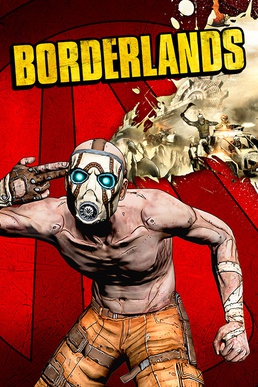
Playing: Borderlands (PS3 version). Pretty cool so far.


Listening to: Tokyo Police Club's Elephant Shell after grabbing their EP A Lesson In Crime off my shelf over the weekend. But it's feeling like it's going to be a very Morrissey Monday Morning.

Thursday, May 21, 2009

Read a book.

I left one of my classes on Tuesday night, and as I was walking out, one of the undergraduates (it's a mixed UG/grad class) asked me if I had finished reading the book for class. We were supposed to have the book read by the next class (Thursday night, aka, tonight) and he said that he had lost his copy. He asked me if he could borrow mine.

1) I had not read the whole book yet.
2) If you lost your book, why would I trust you with mine?

I just said told him that I needed to hold on to it.

This morning, I received an email from this same student, sent to everyone in our class. (It was sent last night.)

Please anyone i went at ll the bookstores and i even went gainesville in search of the book. i couldnt order online because it will not be in time. Can i photo copy the book please i have no other choice went to paperback, barnes and noble, books a million, bills, fsu bookstore, and boarders . Please i need ur help please respond

(I added the italics.)

No greeting, not even the title of the book (even though we're only using one at the moment). Didn't say for what class (even though it sort of says in the email subject, was was: "I Need Your Help: ENL4333").

My favorite part of the email is that he "went gainesville" [sic] in search of the book. I obviously have no way of verifying that, but it seems very, very unlikely. Maybe he was headed to a party down there, and he was like, "Might as well check around to see if that book is here."

This is the same student, it might be noted, that was playing with his water bottle (throwing it up high in the air, throwing it around) before and after class, and who, in class, brings up ridiculous interpretative theories of our readings.

Wednesday, April 15, 2009

This Is Capitalism.

I just had the unique experience of being excited, inspired, and disgusted all at the same time.

On my lunch hour, I meandered over to the campus bookstore. I was looking at a section of books that were a mixture of new releases and current bestsellers when I spotted a tiny white hardcover book near the bottom. Upon closer inspection I saw:


This Is Water: Some Thoughts, Delivered on a Significant Occasion, about Living a Compassionate Life

By: David Foster Wallace


Luckily, Amazon.com has the short author bio that I saw on the back bookflap:

David Foster Wallace is the author of the novels Infinite Jest and The Broom of the System and the story collections Oblivion, Brief Interviews with Hideous Men, and Girl With Curious Hair. His nonfiction includes the essay collections Consider the Lobster and A Supposedly Fun Thing I'll Never Do Again, and the full-length work Everything and More. He died in 2008.


Next, I checked the description of the book:


Only once did David Foster Wallace give a public talk on his views on life, during a commencement address given in 2005 at Kenyon College. The speech is reprinted for the first time in book form in THIS IS WATER. How does one keep from going through their comfortable, prosperous adult life unconsciously? How do we get ourselves out of the foreground of our thoughts and achieve compassion? The speech captures Wallace's electric intellect as well as his grace in attention to others. After his death, it became a treasured piece of writing reprinted in The Wall Street Journal and the London Times, commented on endlessly in blogs, and emailed from friend to friend.


They should have added: "And now, Little, Brown is trying to turn a profit from it." (The bookstore's price was $14.99.)

This commencement speech, prominently displayed in a university bookstore, is supposed to dole out little nuggets of wisdom to graduating seniors. I wonder if any of the parents who end up buying their children this book will read it. I wonder if any of them knew who David Foster Wallace was.

I'll admit that I don't know too much about the man, but I've read a few essays by him --- enough to convince me that he would not take kindly to this sort of release. Why not hold off until a collection of his unpublished work comes out and add it to that? Or add it to a biography of him that comes out?

This seems like a sick attempt to cut a profit from Wallace, who was a great writer. I was excited to see another piece of his work getting published, but I was disgusted when I realized that I could have easily found this online. In fact, it was the first link delivered from a simple Google search.

So how does anyone besides the publisher profit from this? The book was no bigger than my hand. The publisher literally spaced out every sentence onto a separate page, making the small book 137 pages. I was able to read it in 20 minutes. ($14.99???)

The saddest part is that Wallace mentions suicide in his speech, and there is no mention anywhere in or on the book that he himself eventually succumbed to it. Wallace was expanding on the claim that college is supposed to "teach you how to think." He mentioned the mundane existence of day-to-day adult life driving around in traffic and going to the grocery store. He said that college really just tries to teach you what to think about, and how to control your own thoughts about things to stop you from going crazy.

I think the publisher owed it to the audience to mention that Wallace committed suicide after a long struggle with depression. It's grotesque, yes, and it may be uncouth to mention in the author bio, but it's an important aspect of him that gives more meaning to his words. The publisher is trying to get away with a gimmicky release. They're trying to trick helicopter moms into buying this famous graduation speech from this famous writer.

How could anyone have thought this was a good idea?

(Now, I don't know the particulars of the publication. I suppose the family or estate must have cleared it, and maybe all of the proceeds are going to a charity for depression awareness. And, in fact, some of what this book/speech is getting at is thinking about the alternatives to your gut reaction. My default setting was to despise the publisher for cranking out this tiny piece of crap book, when maybe it's doing the Wallace family justice by donating proceeds. It's certainly getting his name out a little bit more.)


David Foster Wallace, whose prodigiously observant, exuberantly plotted, grammatically and etymologically challenging, philosophically probing and culturally hyper-contemporary novels, stories and essays made him an heir to modern virtuosos like Thomas Pynchon and Don DeLillo, an experimental contemporary of William T. Vollmann, Mark Leyner and Nicholson Baker and a clear influence on younger tour-de-force stylists like Dave Eggers and Jonathan Safran Foer, died on Friday at his home in Claremont, Calif. He was 46.

A spokeswoman for the Claremont police said Mr. Wallace’s wife, Karen Green, returned home to find that her husband had hanged himself. Mr. Wallace’s father, James Donald Wallace, said in an interview on Sunday that his son had been severely depressed for a number of months.

("David Foster Wallace, Influential Writer, Dies at 46"


Edit:

I want to point out the following sentence in the book's description:

"The speech is reprinted for the first time in book form in THIS IS WATER."

This is somewhat deceptive. It means literally "This is the first time this essay has been released as a standalone book," which could also mean "This is the first edition of the reprint of this essay." Could you imagine the first time that a book was released where it said "This is the first time anyone ever published this as a book. It existed as manuscripts for a long time, but we were first!!!"

I only bring this up because between the time I posted and now, I discovered that this commencement speech was included in the Best American Nonrequired Reading for 2006. The Best American series is a massively available series. This just adds to the idea that Little, Brown is trying to cash in big time on this little book --- this essay was already printed in a book.

In case you're interested, here is the reprint of this essay in the Wall Street Journal.

Tuesday, January 06, 2009

Memory expert.

Over the winter school break, I also read a book about a Russian memory expert, "S."

The Mind of a Mnemonist
By: A.R. Luria

It was a translation of a book from a Russian psychologist who studied this mnemonist who made a living performing feats of memory. He would get paid to put on shows where people just read off a list of words or nonsense syllables, and S. would repeat them back. Or study a chart of numbers. Or recall lines from Dante's Inferno in Italian, a language he did not know, after hearing them recited once.

S.'s method (he has a real name that I forget -- it's in a Psychology textbook somewhere) was synethestic in nature -- he would form a little short story out of images that he saw from each word or number. Anything he heard, he could either taste or see. Voices were metallic. Pitches were lengths of silver, or white, or orange.

It's a fascinating take. Just imagine processing the world this way -- as a kid, S. could imagine that he actually went to school, and think that he did, when he was still in bed. He just pictured it. He could raise or lower his body temperature by envisioning himself out in the cold or in extreme heat. He could raise and lower his heartbeat too.

There were sad parts -- he had trouble getting the general meaning of things. And he always felt like something great was going to happen to him, or he would do something great. He seemed to live in a haze most of his life.

Very interesting read.

8/10 stars.

Choices, choices, so many choices.

I read a book on choices. It was called:

The Paradox of Choice: Why More Is Less
By: Barry Schwartz

Great title. I thought it should have included a ghost or something.

It was a fun read -- a fast read. Much of the things I read I knew about already. We have too many choices available nowadays. Size of jeans, comfort fit, boot fit, relaxed. Stonewash, faded, colored. Every product comes in different forms.

His idea was that this growing number of choices made people unhappy and unfulfilled, because they always felt like they could find and obtain something better than what they had. Since there are so many choices, it's up to the individual to make the right decision, and afterwards, if things go wrong, we can always blame ourselves for not picking better.

He used real-world examples from shopping marts, employers (health insurance, 401k enrollment), and other situations where we're faced with an ungodly number of choices.

It was good to read through things and realize that everyone is swamped with decisions all the time. But it wasn't that successful in suggesting things to do about it. It's more of a "be aware" book.

6/10 stars.

Monday, December 15, 2008

2 Movies, 1 Book.

As I continue to struggle with a seemingly endless amount of options following the completion of my current degree (Ph.D. program?, job?, both?, which kinds?), I'm constantly consuming media in what I think is my extended window of opportunity for learning about other fields. (Which is not to say that I don't think I can learn about other things after I get a job, a career, or a specialty in academics. It is more of a personal belief I have based on things I learned so far that I don't want to take the time to explain at this moment. So there.)

For example, I have about 10 books checked out from the library on different subjects, ranging from sociology, psychology, language, and history. A few of the titles:

The Psychology of Abortion
A Mind of Its Own: A Cultural History of the Penis
The Mind of a Mnemonist
The Paradox of Choice: Why More Is Less

Okay -- I'll concede that all of those have tenuous ties to psychology.

Nevertheless! The purpose of this post is to recount the things I did this weekend...

Movie 1


I picked up The Wild Parrots of Telegraph Hill from the student library on a recommendation I heard from one of my classes this semester. It's a 2005 documentary (with a soundtrack straight out of 1986) about a free spirit guy, Mark Bittner, who moved to California in search of a music career, then did a few odd jobs before realizing that he didn't want to work at all. Somehow, he ended up in an unused cottage on Telegraph Hill in San Francisco. The owners of the property were okay with it... until they decided they wanted to renovate the place. So Mark is given the boot at the end of the movie, and he leaves behind his precious parrots, but don't worry -- it's not all bad in the end.

This movie was very powerful. Mark is a very spiritual dude, and it brought out a bohemian part of me. I too wanted to grow my hair long, shed my office job, and just feed the parrots. Of course, he made a lot of sacrifices doing this, but that's to be expected.

Highly recommended.

Movie 2


Sunday held 2006's The Fountain. It's a beautifully filmed, hard to categorize movie. It's got elements of sci-fi, fantasy, and even a little bit of horror. But it's also weirdly realistic and you can easily identify with it.

It's a very powerful movie, but when I tell you the plot line, it will sound very cheesy. Here we go: There's this dude. And there's this chick. There's a love story. And there's a story about immortality. And time-traveling. Well, not exactly time-traveling, so much as time-hopping in the narrative. So it's a love story across the ages. (The trailer said 1500 A.D., 2000 A.D., and 2500 A.D., though there's no specific mentions of these dates within the movie itself.)

I'd also recommend seeing this movie, though I'd suggest watching it on a fairly nice day, so you can go out and appreciate nature and society after watching it. (I.E. -- It's a bit of a downer at times.)

Book


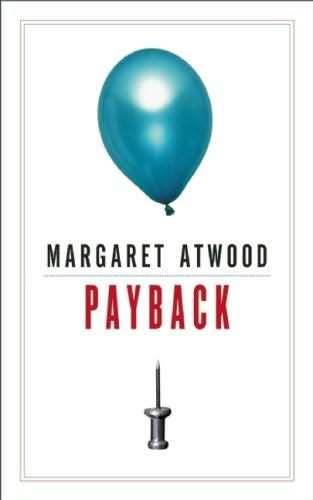
The book I breezed through this weekend was by renowned writer Margaret Atwood. Titled Payback: Debt and the Shadow Side of Wealth, I thought it would be an interesting read. It was. (Excerpt here.)

But it wasn't what I expected. Instead of a writer's perspective and analysis of the current debt situation, it was instead a writer's perspective on the term debt and it's meaning throughout the ages. Atwood is an apt student of the arts and humanities (especially plays), and she does a few sweeping analyses of religion, plays, literature, and other forms of the arts in her survey of what debt has meant, how it's repaid, and how it helps and hurts both the creditors and the debtors.

There are no practical tips here, but there are a few neat revelations. Of how Ebeneezer Scrooge resembles Faust, of how Shakespearean drama fits in, of how religions view moral/spiritual debt, et al. So, if you'd like to read about the philosophical concept of debt, give this a shot. If you want some more practical tips, check elsewhere.

Overall, it was a good weekend.

Tuesday, September 09, 2008

Forest for the Trees.

I'm currently reading Betsy Lerner's The Forest for the Trees: An Editor's Advice to Writers and the first half was very engaging. It was all about writers' personalities and finding the muse and all that. Lot of great quotes, lot of great anecdotes -- the lady worked for 10 years as a book editor and now works as a literary agent for authors.

I'm also reading The Iliad, which is less engaging, to say the least.

Sunday, August 31, 2008

New books.

All apologies to my stalwart readers: I have been busy at my job with the first week of college classes, with my own academic pursuits, with reading, with writing. Not so much 'rithmatic.

I have read voraciously over the summer. After finishing A Heartbreaking Work of Staggering Genius (Dave Eggers) a couple weeks ago, I was worried that I wouldn't find anything else that could keep my attention or pique my interest.

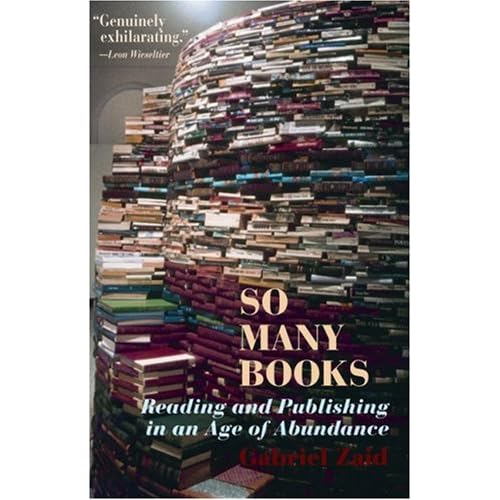
By chance, I've come across a number of books that I have started (many just a few pages) and that look like they will be enjoyable. I'm already mostly through Gabriel Zaid's So Many Books, which is required reading for my "Intro to Editing and Publishing" class this semester.


It is a pleasantly short read, and it mostly comes off as a self-help book for writers and readers. It alternates between supporting your dreams of becoming published (most books need only a few thousand readers to make money) and squashing your hopes of making it big with a book (millions of books are printed -- much more than are read -- and yours will turn into a chunk of paper garbage in a growing heap). Along the way are delightful anecdotes and interesting statistics. The author is Mexican and it was translated, but it comes across splendidly in translation. Very fresh. I think it should be required reading for anyone who plans to write a book, or anyone who reads books.

The next couple are by David J. Levitin and deal with music in the brain and cognitive neuroscience: This Is Your Brain On Music, and The World In Six Songs. Interesting material that I may review later if I get around to reading them.

There are others, of course. So many others...

Friday, July 25, 2008

Fall course.

I just grabbed a contemporary lit course for fall. I'm excited about it because it has the following required book list:

Flying Home and Other Stories: Ralph Ellison
As I Lay Dying: William Faulkner
Portrait of a Lady: Henry James
Jesus' Son: Denis Johnson
Slaughterhouse-Five: Kurt Vonnegut
House of Mirth: Edith Wharton

...Not so much about the first and the last books, but since I've read one (Slaughterhouse) and have started another (Portrait) and another (Jesus' Son) looks pretty cool and I've wanted to read Faulkner with guided instruction, I think it'll be pretty cool.

Here's to hoping that the professor is not a wackjob.

Tuesday, June 24, 2008

The Google Story.

My current reading is by David Vise and Michael Malseed.


The authors are journalists from The Washington Post and therefore is fairly straightforward and . . . journalistic. I enjoy the style.

The first half of the book was pretty entertaining -- it went through the background of Larry Page and Sergey Brin, once rival Stanford Ph.D. students, now multi-billionaires. It was interesting because I didn't know anything about the story, or how hot Stanford was (is) in computer science and how the scene benefited from being close to Silicon Valley as well as being close to some venture capitalists. Also interesting was that Stanford specifically fostered an atmosphere where star students were encouraged to work on commercial ventures with their professors, who would take a stake in their students' companies and become stinking rich. There was a point where a Stanford student said that it was hard to go to parties, because there would always be people around offering them a high-paying job to quit school and work for them.

And although Page and Brin came from a strong background of academia, they were "forced" to leave grad school to manage their system because only they could do it right. Boo hoo.

But now the book is slowing down in the second half. I just read an entire chapter on different people that use and love Google. But I just hit another fascinating part, actually, about when Gmail was unveiled.

Apparently, everyone went Chicken Little on the guys because they thought that having an entire gigabyte of storage for everyone would lend itself to government evil-doings (personal privacy for email messages only lasted 180 days). Congressmen introduced state legislature against Gmail, there were petitions, the whole deal. No one seemed to address the fact that this was a voluntary service -- and free at that. In fact, there were only 1,000 accounts available at first, just to test it out and make it generate some mystique.

If you don't want to allow yourself to be tracked (another big issue was scanning Gmail messages to display relevant ads), just don't use the service. Everyone else complaining that this sort of service would snowball and soon everyone would be at risk everywhere are morons. Gmail has only made others try harder on what is still lousy online email services.

There are a few things that are not explained. I would have preferred a more detailed, slightly more technical explanation of the Google search method. But it does say that the guys started out using a lot of cheap parts and building a string of cheap personal pcs, linked with custom-written software. And then they just started downloading every page of the internet so they could search through it quickly. Which is pretty ingenious.

Also, apparently all of this background information is online too.

Whoa, and so is your Google History.

Thursday, December 30, 2004

Done.

I've finally completed the vast biography of Alexander Hamilton that I have read off and on for at least five months. I consider my time and money involved with it well spent. It was a fascinating read- engrossing most of the time (even when Chernow wrote about finances and The Federalist Papers, the material was unusually interesting). It really read like a narrative; I was never much into biographies, but I started last year with Humphrey Carter's take on Tolkien, and I went from there. I took a chance on Alexander Hamilton after I read a few pages of the introduction and realized it was going to be reeeaaally good. It was.

731 pages.

Tuesday, December 07, 2004

C.S. Lewis, A life by Michael White

C.S. Lewis, whose advice to avoid discarding any of your writings no matter how trivial they seem I've taken to heart for years, apparently had his older brother Warren burn a substantial bundle of his own papers after his death. Among the papers were believed to be unfinished manuscripts of novels, personal letters, and essays. Biographer Michael White states that among the letters were correspondence between Lewis and Janie Moore, the mother of one of Lewis's wartime buddies. In a strange relationship, Lewis and Moore fell for each other after Paddy (Lewis's friend and son of Janie) died in the Great War. Lewis was 19 and Janie 45 when they first met.

One beef I have with this biography is that it seems White quotes or refers to Lewis's autobiography on nearly every other page. Makes White's account seem rather extraneous- like I should just go and read Surprised by Joy. Oh, well.

Tuesday, November 09, 2004

I am Charlotte Simmons.

Alright, the new Tom Wolfe novel, I am Charlotte Simmons, comes out today (November 9th, 2004)! I read an excerpt from it this past summer in a Rolling Stone issue. Turns out Wolfe went to various universities across the nation (from Stanford to UF), researching his novel on the modern times of university life (see title of this blog).

Listen to an interview with Wolfe here.

Read a review here.

Heck, win a trip to talk to Wolfe here!

This book is going to the top of my Christmas list (hint, hint).

Monday, September 13, 2004

Language.

My new favorite, completely grammatical sentence is "Buffalo buffalo Buffalo buffalo buffalo buffalo Buffalo buffalo." Let me break it down for you- a similar sentence would be something like "The tiny animals that tigers eat often eat other tiny animals." American bison from Buffalo, New York can be called “Buffalo buffalo.” (adjective, noun) So, replacing every noun (and adjective) in the sentence with “Buffalo buffalo,” then “The Buffalo buffalo that Buffalo buffalo eat often eat other Buffalo buffalo.” Now, “buffalo” can also be a verb (“to overwhelm, to intimidate”). So, replacing the verbs with buffalo, “The Buffalo buffalo that Buffalo buffalo buffalo often buffalo other Buffalo buffalo.” Now, removing unnecessary words (like in “Tiny animals tigers eat eat tiny animals”) we have “Buffalo buffalo Buffalo buffalo buffalo buffalo Buffalo buffalo.”

For more amusing language tricks, consult “The Language Instinct,” by Steven Pinker.

Sunday, August 22, 2004

Alexander Hamilton

A recent biography of Alexander Hamilton by Ron Chernow is my current reading. Chernow does a wonderful job of painting a vivid potrait of the founding father, who overcame many obstacles and accomplished much before even becoming the Secretary of Treasury for the United States.